
Have you ever seen a photo featuring what looks like lights bouncing across the page? These light trails appear almost blurry and smeared against the background, and are likely to be a result of ‘long exposure’.
Long exposure photos are incredible to see, and are very effective at portraying a sense of movement and time in deceptively stationary scenes.
If you’d like to try your hand at long exposure photography, we’ve put together this guide covering everything you need to know, from the best Fujifilm cameras for the job to how to print your snaps with our UK-wide photo printing service.
What is long exposure photography?
Long exposure is a photography technique that creates ethereal, dreamlike visuals. How does it work? The effect is created by leaving the camera’s shutter open for longer than usual.
With a slower shutter speed, you’re essentially giving your camera more time to gather light over several more seconds, or even minutes. As a result, you’ll be able to create shots that effortlessly blur any moving objects, whether that be a waving light, stars in the sky, or car headlights.
The beauty of this technique is that the stationary elements in the shot will remain still, while the moving elements dance across the photograph, creating an almost mystical effect. This is why many like to capture moving lights in this way.
How to do long exposure photography
The good news is, long exposure photography is much easier than it looks. You just need to have a good understanding of your camera and its settings. Here’s a step-by-step with a few long exposure techniques, tips, and tricks thrown in for good measure:
1. Use a tripod (a must!)
With a slower shutter speed, your camera will be extremely sensitive to any movement, no matter how small. This could potentially result in a completely blurred frame.
With this in mind, it’s important to keep your camera as stable as possible. The best way to do this is with a reliable tripod.
2. Switch your camera to manual mode
Manual mode will give you full access and control over your camera’s shutter speed (how long the sensor is exposed), aperture (size of the lens opening), and ISO (sensor sensitivity). You’ll need to switch to manual mode to adjust these settings next.
3. Set your shutter speed
Knowing the best timing comes with practice, as it depends on what you’re shooting. We recommend:
- 1 – 2 seconds for gentle moving water.
- 3 – 5 seconds for car lights.
- 10 – 15 seconds for faster-moving water.
- 15 – 30 seconds for bustling cityscapes and starry skies.
- 30+ seconds (also known as Bulb mode) for star trails, fireworks, and dramatic low-light scenes.
Essentially, just remember: the longer you leave your shutter open, the more movement it will capture.
4. Adjust your aperture and ISO
Aperture and ISO are two very important settings when it comes to long exposure photography. Aperture controls how much light passes through the lens and how much of the image stays in focus, while ISO controls your camera sensor’s sensitivity to light.
Our best tip for long exposure night photography or long exposure street photography is to take a test shot after each setting adjustment. It will take time and patience, but when the balance is right, the results speak for themselves.
Aperture settings for long exposure photography
- f/2.8 – f/4: Allows lots of light into the shot. Ideal for dark scenes, but bear in mind the background will look blurry with subject focus only.
- f/5.6 – f/8: A good all-rounder aperture for long exposure shots. Delivers a good balance of light with sharpness.
- f/11 – f/16: Ideal for photographs capturing movement from subjects like babbling waterfalls and coastlines, while keeping the shot sharp as a whole.
- f/22+: Best for bright settings and if you’d like a softer image.
ISO settings for long exposure photography
- ISO 100 – 200: Best quality with little to no grain, always ideal.
- ISO 400 – 800: Brighter but slightly grainier. Best to use if it’s dark and you need to add more light to your shot.
- ISO 1600+: Adds lots of noticeable grain and noise, so best to use only if it’s very dark and you can’t adjust with a longer shutter speed.
5. Use a remote shutter release or self-timer function
Like we said earlier, slow shutter speeds make your camera very sensitive to knocks, jolts, and even slight presses. With this in mind, it’s best to use a remote shutter or an expertly timed self-timer function instead of manually taking the shot yourself.
The best Fujifilm cameras for long exposure photography
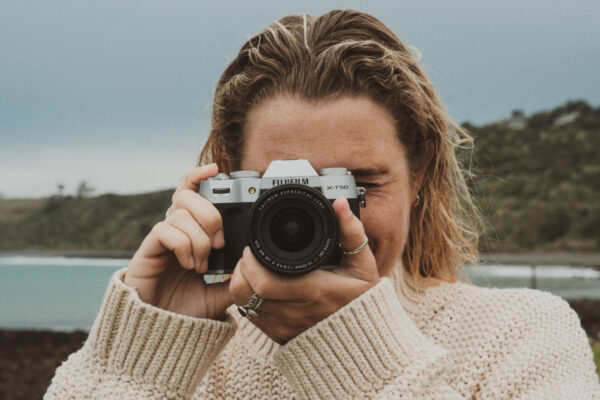
If you’re looking for the best long exposure camera that balances image quality with intuitive manual controls, we have a few standout Fujifilm cameras available for loan in our collection:
- Fujifilm X-T5: With its detailed 40MP sensor and user-friendly dials for intuitive control, the X-T5 is perfect for long exposure photography. It’s also very lightweight at just 557g and highly portable.
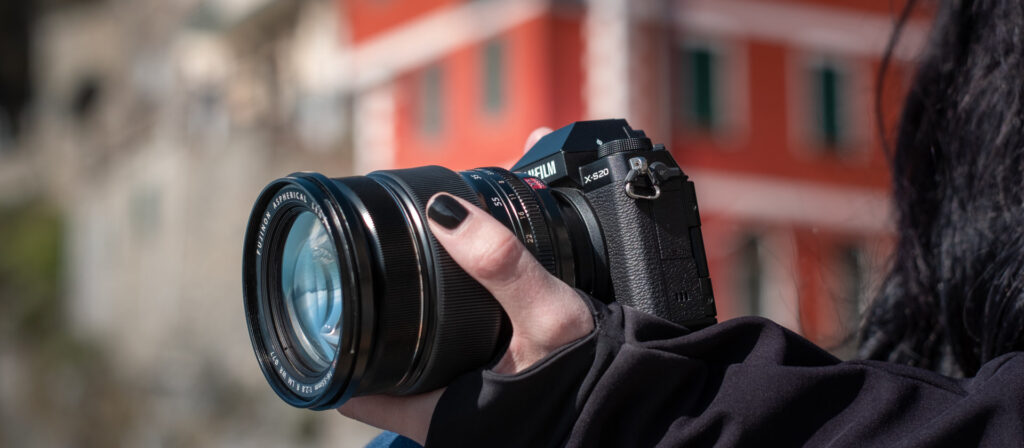
- Fujifilm X-S20: The X-S20 offers excellent low-light performance with its 26.1MP X-Trans sensor and in-body image stabilisation (IBIS), ensuring steady shots even in challenging conditions. Ideal for both stills and video.
Print and display your photos with PHOTO by FUJIFILM
Once you’ve mastered the art of long exposure photography, all that’s left to do is showcase your work.
At PHOTO by Fujifilm, we’ve partnered with over 150 independent retailers across the country, so a high-quality photo printing service is never too far away from your door.
Choose from a variety of photo products, including:
- Prints and enlargements
- Wall art
- Photo posters
- Photo books
- Photo gifts
- Framed photos
With over 80 years of photography printing experience behind us, you can trust that your long exposure shots will be produced in print with the utmost accuracy, vibrancy, depth, and detail.
Find your nearest PHOTO by Fujifilm store today
Ready to print your long exposure photographs? Head to our Store Locator, type in your postcode, select the type of photo product or service you’d like, and either shop online or in-store with your selected local retailer.
Fujifilm quality guaranteed, no matter where you are.